
You see artificial intelligence everywhere, from our communication to decision-making. Whether it is a healthcare diagnostic system or a credit scoring system, AI is now part of many important operations.
However, with its growing influence, it is necessary to understand the importance of AI ethics: the practices that make AI safe. Without these ethics, AI can amplify bias and violate privacy.
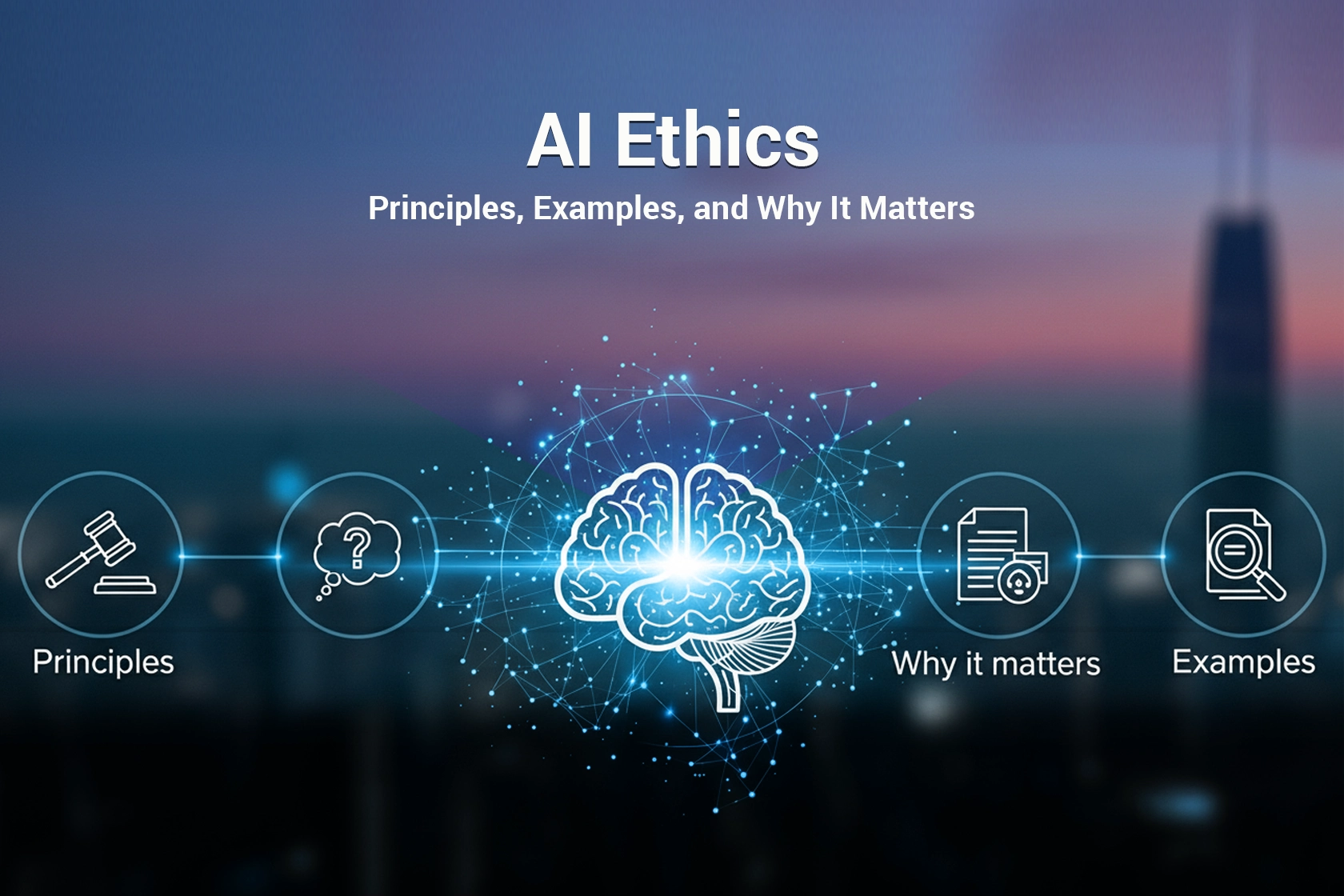
This guide explores what AI ethics is, provides real-world examples, and explains why it matters for individuals, businesses, and society.
Key Takeaways
- AI ethics ensures transparency, fairness, and accountability in AI systems.
- The most important ethical concerns include bias, privacy, and explainability.
- Ethical AI builds trust and reduces reputational and legal risks.
- For responsible AI adoption, human oversight and strong governance are extremely important.
What is AI Ethics?
AI ethics are the set of all principles that guide stakeholders (from engineers to government officials) to develop and use AI responsibly. In the context of AI SaaS platforms, these principles are particularly important because AI models are delivered at scale, impact multiple customers, and also process sensitive cloud-hosted data.

These principles ensure a safe, secure, and environmentally friendly approach to artificial intelligence. A responsible AI deployment should include avoiding bias, ensuring the privacy of user data, and reducing any environmental risks.
Why are AI Ethics Important?
AI ethics are necessary because they are designed to support human intelligence. But if this technology is not governed ethically, it can reinforce inequality, undermine privacy, and create social harm.

For businesses, ethical AI reduces legal risks, protects brand reputation, and builds customer trust. For users, it ensures transparency, fairness, and accountability. For society, it helps align technological progress with shared human values.
When it comes to SaaS companies, ethical AI should be the standard. AI-powered SaaS products impact pricing, hiring, content moderation, and customer interaction. A single biased model can affect thousands of users at once. It also increases legal, reputational, and compliance risks.
Understanding Stakeholders in AI Ethics and Governance
Industry-relevant people, business leaders, and government representatives collaborate to design ethical principles for AI fairness and transparency.

- Academics: Researchers and professors are responsible for creating theory-based statistics, ideas, and research.
- Government: Agencies and committees within a government can ensure that AI is used ethically.
- Intergovernmental Entities: Organizations such as the United Nations and the World Bank have the responsibility to raise awareness and draft AI ethics guidelines.
- Non-profit Organizations: Non-profit organizations, like Black in AI, represent diverse groups within AI technology.
- Private Companies: Executives at large companies, such as Google and Meta, as well as healthcare, banking, consulting, and other private sectors, are also responsible for creating ethics teams and codes of conduct.
Core Principles of AI Ethics
When we talk about responsible AI, the center of discussion is always people’s well-being. There is no universally agreed-upon set of ethical AI principles.

Organizations and the government consult experts in AI, law, and ethics to make these guiding principles, which commonly address the following.
- Human Dignity: AI systems should always ensure the well-being, dignity, and safety of people. They should not replace humans and compromise on their welfare.
- Human Oversight: AI systems need human monitoring during development and use. It shows that ultimate ethical responsibility is on human beings.
- Mitigating Bias and Discrimination: AI designs should prioritize fairness, equality, and representation of every group to reduce bias and discrimination.
- Transparency and Explainability: The entire decision-making process of AI models should be transparent and clearly explained in plain terms.
- Data Privacy and Protection: AI systems should have the strictest data privacy and protection standards. They should use robust cybersecurity methods to avoid data breaches.
- Inclusivity and Diversity: AI technology should respect every human, regardless of their identity and experiences.
- Economies and Society: AI should help in economic and societal prosperity for all people, without any unjust or unequal practices.
- Digital Skills and Literacy: AI technologies should be easy enough to be understood by everyone, regardless of people’s digital skills.
- Business’s Health: AI business tools should speed up important processes, increase efficiency, and promote growth.
Key AI Ethical Issues
There are numerous challenges that represent AI ethics.

Biasness
When AI does not collect data that accurately represents the population, it produces results that reflect bias. For instance, Amazon’s AI recruiting tool rejected resumes that had the word “women” in them in 2018. Basically, it discriminated against women and caused legal risk for the company.
Privacy Issues
AI takes data from internet searches, social media posts, online purchases, and more. While this approach helps personalize the user experience, there are also concerns raised about the lack of consent for these companies to access users’ personal information.
Environmental Concerns
Many AI models need a lot of energy to train on data. This raises questions about our environment and its safety. While research is being done for energy-efficient AI models, more could be done to add environmental considerations to responsible AI-related policies.
Real-World Examples of AI Ethics
The following examples illustrate the ethics of artificial intelligence.

Deepfakes and Misinformation
The popularity of AI has started a new era of misinformation. In 2022, a deepfake video of the Ukrainian President went viral in which he was telling his soldiers to surrender.
Moreover, every other day, there are harmful deepfake videos targeting women and children. This raises concerns about people’s privacy.
Lack of Accountability and Transparency
In 2019, Apple’s AI-powered credit offered significantly different credit scores to men and women, despite them having similar financial profiles. This case highlights why it is important to make AI-driven decision-making on SaaS platforms auditable and explainable, particularly in high-stakes markets like fintech and enterprise software.
Not Giving Credits to Owners
In 2022, Lensa AI used artificial intelligence to create cartoon-looking pictures of people based on their regular photos. Some people criticized the app for not giving credit to artists who created the original art on which the AI model was trained. It also came to light that Lensa AI was trained on billions of photos taken from the internet without consent.
Job Displacement and Economic Inequality
AI can enhance productivity, but it also threatens to automate millions of jobs. Uber invested in self-driving technology, primarily to reduce the need for human drivers. However, it scaled back, but it shows how different corporations are testing AI to cut labor costs.
AI Ethics in Business and Technology
Organizations that prioritize transparency in AI systems gain a competitive edge. Ethical AI practices improve customer experience, support compliance, and encourage long-term innovation.
Many companies are increasingly adopting ethical guidelines, conducting AI audits, and embedding ethics into product development. For any business, ethical machine learning has become a necessity.
How to Create Ethical AI
Building ethical AI needs careful examination of the ethical impacts of policy, education, and technology. Regulatory entities can ensure that this technology benefits society rather than harms it.

The good part is that governments have started enforcing ethical AI policies that outline how companies should address legal issues related to bias or other harm. Anyone who uses AI should understand the negative impact of AI.
It is counterintuitive to use technology to detect harmful behavior in other forms of technology, but AI tools are excellent at detecting whether a video, audio, or text is fake or real. These tools can highlight biases and unethical data sources more efficiently than humans.
The Future of AI Ethics
With the evolution of AI, ethical challenges will also become complex. The future of AI ethics lies in stronger governance, global collaboration, and better explainability on the part of policymakers, technologists, and society.

Advances in ethical machine learning and transparency tools will help ensure that AI systems remain fair, accountable, and trustworthy.
Final Thoughts
AI ethics is more of a societal responsibility than just a technical concern. By focusing on fairness, transparency, privacy, accountability, and human-centered design, we can ensure that artificial intelligence remains beneficial for everyone.
Ethical use of AI builds trust in artificial intelligence, protects human rights, and supports responsible innovation. As AI continues to shape the future, ethics must remain at the center of its development.
Feel free to visit Latest SaaS Updates for more interesting SaaS-related information.
FAQs
How can Companies Test AI Systems for Bias Before Deployment?
Organizations can run biased audits, test models on different datasets, and use fairness evaluation tools before releasing AI systems.
What is the Role of Explainable AI in Ethical Decision-Making?
Explainable AI helps users understand how decisions are made, improving trust, accountability, and regulatory compliance.
Are AI Ethics the same across all Countries?
No, AI ethics differ across regions. For instance, frameworks like the EU AI Act impose stricter regulations than many other jurisdictions.
Can Ethical AI slow down Innovation?
Yes, implementing ethical AI can slow down innovation by introducing, developing, and auditing complex and time-consuming safety frameworks. While it can hinder speed, it also ensures long-term sustainability, user trust, and legal compliance.
How can a Startup Implement Ethical AI with Limited Resources?
To adopt ethical AI, startups can use ethical AI checklists, prioritize transparency, use pre-trained responsible AI models, and document the decision-making process.
