
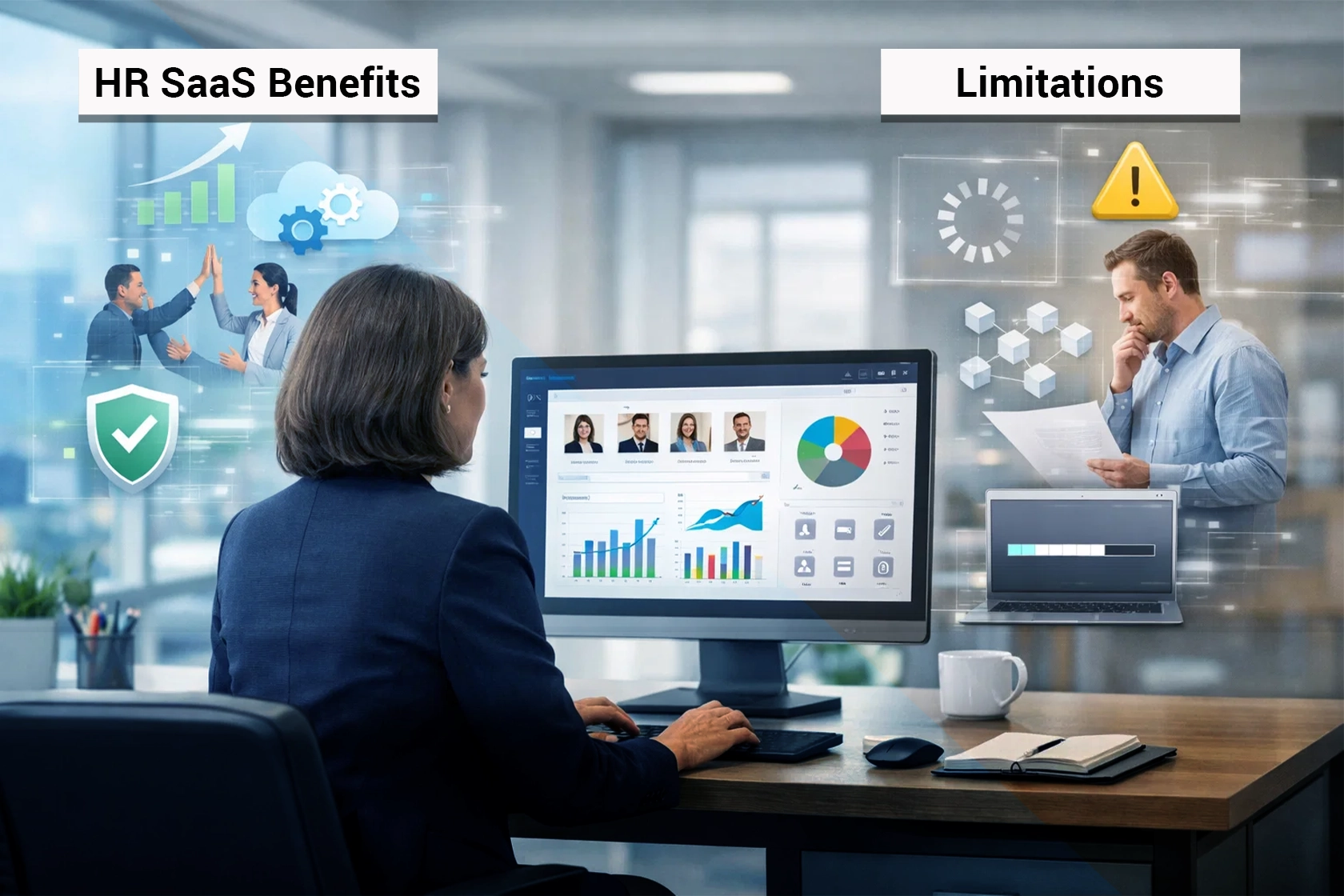
Today, HR teams are under more pressure than ever. They have to manage distributed workforces, stay compliant with changing regulations, and do it all in tighter budgets. This is the reason why HR SaaS has become a popular solution for businesses looking to modernize how they manage people.
However, just like with any technology, HR SaaS software is also not a perfect fit for everyone. Before you invest in it, it’s worth understanding what it does well and where it falls short, which we’ll cover in this guide.
Key Takeaways
- HR SaaS software reduces costs and improves efficiency through automation, pricing, and reduced need for IT resources.
- It offers scalability and remote access and is ideal for growing, distributed, and hybrid workforces.
- Customization limits, vendor lock-in, and security are important to consider before investing in this software.
Rise of HR SaaS: A Quick Context
Organizations are rapidly shifting away from traditional on-premises HR systems because they are costly to deploy, require manual updates, and offer limited remote access. HR SaaS, on the other hand, offers real-time access, automation, scalability, and easier compliance management (see: HR SaaS vs Traditional HR Software: Differences Explained).

Today, around 60% of companies use cloud-based HR software. Moreover, this industry is projected to reach $5.15 billion by 2027 and $28.19 billion by 2035.
The Benefits of HR SaaS Software
Let’s see what benefits this technology offers.
Lower Costs and Stronger ROI
One of the strongest points of cloud-based HR solutions is their pricing structure. Unlike traditional HR software, which requires a hefty upfront investment, HR SaaS offers predictable monthly or annual subscription fees.

Additionally, the ROI comes from time saved. Teams can automate different HR tasks, such as onboarding workflows, leave approvals, and payroll processing, reducing administrative hours. Companies moving to cloud HR systems see a 325% ROI, while organizations already using cloud tools see a 100% ROI when they upgrade to better software.
Fast Deployment and Easy Scalability
Companies can start using HR SaaS platforms in a few days to a few weeks, unlike on-premises software, which can take months. There is no hardware to install and no lengthy IT configuration required.
Scalability is another benefit. You can keep adding more users and active new features as your team grows. Even when you downsize, you can scale back just as easily.
HR Process Automation
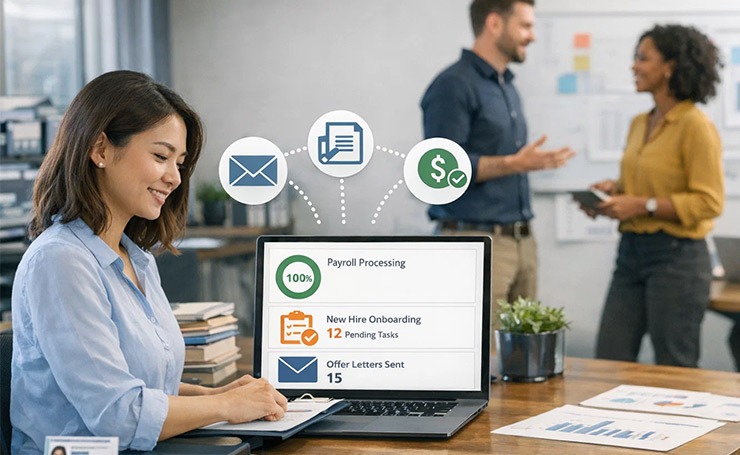
Cloud-hosted HR systems can automate a wide range of repetitive, tedious tasks. From sending offer letters and collecting new hire documents to running payroll, it handles everything. This frees the HR team from time-consuming administrative tasks and allows it to focus on higher-value work such as culture building, workforce planning, and talent strategy.
Employee Self-Service
Most HR SaaS solutions include employee self-service portals where staff can update personal information, request time off, access company policies, and download payslips. This alone dramatically reduces the volume of routine HR queries, thereby improving efficiency and the employee experience.
Real-Time Analytics and Reporting
With this modern software, you do not have to gather data from multiple spreadsheets to create a headcount report. It has live dashboards covering attrition, hiring pipeline, absenteeism, compensation benchmark, and more. Leaders can make quicker, more informed decisions when data is always current and accessible.
Remote Access and Workforce Mobility

As this HR system is hosted in the cloud, it is accessible from anywhere and any device with an internet connection. HR managers, employees, and leadership can access it whether they are in the office, working from home, or traveling. It is one of the most attractive advantages for remote and hybrid teams.
Built-In Compliance Support
Keeping up with data privacy regulations, labor laws, and tax changes can be burdensome for HR teams. Cloud-based HR systems include built-in compliance features within the platform. They also have certifications like ISO 27001 and SOC 2 Type II, highlighting that your data is handled responsibly.
The Limitations of HR SaaS Software
Now, let’s take a look at the limitations of this software.
Implementation Is Not Always Smooth
Despite faster deployment, HR SaaS implementation also has challenges. Migrating historical employee data from legacy systems is often time-consuming. Moreover, integrating with existing tools might also need technical effort and even third-party middleware.

Another challenge is change management. If employees and managers are not properly trained before onboarding, the platform is underutilized.
Data Security Risks
Moving to HR SaaS means that your most sensitive data, like salaries, health information, and bank details, lives on the vendor’s servers. It is a risk that is outside your direct control. A vendor-level data breach affects you even if your own security practices are flawless.
This is why it is important to review the vendor’s security certifications, breach notification policies, data residency options, and its handling of subprocessors.
Internet Dependency
This system only works when the internet does. For organizations with unreliable internet connections or in industries like manufacturing and logistics where workers may not have consistent internet access, this is a huge operational risk.

Also, vendor outages, even if rare, can also temporarily cut off access to critical HR functions. Therefore, always check the vendor’s SLA and review their historical incidents before signing.
Customization Limitations
Most HR SaaS platforms are built on multi-tenant architecture, meaning thousands of customers use the same software simultaneously. This model limits how deeply you can configure the software to support your specific operational needs.
You can customize fields, forms, and approval flows, but if your HR processes are highly complex, the platform forces you to adapt your processes to fit the software rather than the other way around.
Vendor Lock-In
Changing HR SaaS vendors is harder than it sounds. Your data may be stored in proprietary formats that are difficult to migrate cleanly. If you have a long-term contract, you may have to pay early exit penalties. Additionally, retraining staff and rebuilding integrations may take significant time.

To protect yourself, avoid excessively long initial contracts, negotiate data portability rights, and always test data export capabilities during your evaluation.
Hidden Costs
The advertised per-user monthly price is not always the same picture. Implementation fees, data migration support, additional modules, and annual price increases can add up and raise your total cost of ownership.
Before investing, ask the vendor for a full cost breakdown. Ask what is included in the base subscription and what is charged as an add-on.
Quick Comparison: Benefits vs Limitations
| Area | Benefit | Limitation |
| Cost | No large upfront investment | Hidden costs and per-user fees add up |
| Deployment | Fast setup and no hardware needed | Data migration can be complex |
| Security | Vendor-managed compliance and audits | Sensitive data on third-party servers |
| Customization | Configurable for most use cases | Deep customization is restricted |
| Access | Anywhere, any device | Requires a reliable internet connection |
| Scalability | Grows easily with your team | Costs increase significantly at scale |
| Contracts | Ongoing vendor support included | Vendor lock-in risk |
Is HR SaaS Right for Your Business?
HR SaaS is an excellent fit for your most SMBs, growing mid-market companies, and remote or hybrid teams that need a flexible, budget-friendly, and low-maintenance HR solution. If you have limited IT resources and want your HR personnel to focus on people, a cloud-hosted HR system is a strong option.
However, if your company operates in a highly regulated industry with strict data residency requirements, is highly complex, and has non-standard HR processes, you will need to evaluate your options carefully before investing.
Final Thoughts
HR SaaS provides a perfect balance of cost-effectiveness, automation, accessibility, and scalability that traditional on-premises HR systems do not have. But the limitations are real as well. Consider data security, customization limitations, hidden costs, and vendor lock-in before you commit.
Understand your needs, ask the right questions during evaluation, and review the contract to ensure that you are stepping into the right thing.
Feel free to explore the Latest SaaS Updates for more SaaS-related information.
FAQs
Can HR SaaS integrate with Payroll, Accounting, and Recruiting Tools?
Yes, most modern HR SaaS platforms offer API integrations or prebuilt connectors to connect payroll systems, time-tracking tools, accounting software, and applicant tracking systems.
What Features Should I Look for When Choosing an HR SaaS Platform?
You should look for automation workflows, analytics dashboards, integrations, compliance, employee self-service portals, scalability, and security standards.
How does HR SaaS Support Remote and Hybrid Workforce Management?
Cloud-hosted HR systems enable employees and managers to access HR tools from any device. The access is not limited to a specific region. Employees can submit leave requests, track attendance, and collaborate from anywhere, making it ideal for distributed teams.
