

In this technological era, the education sector has gone through some major transformations as well. One thing that revolutionized this industry is the integration of Edtech SaaS. The traditional education models have their limitations. This SaaS tool provides cloud-based, scalable solutions for modern learning.
It focuses on skill development and continuous training. From a virtual classroom to AI-driven learning experiences, this SaaS is becoming prevalent in academic and professional environments.
In this blog, we will discover some major aspects of Edtech SaaS and what role it plays in the evolving demands of modern learners. Read on to see how educational institutes and enterprises embrace this solution.
30-Second Summary
The cloud-based models are becoming prevalent in the field of education as well. The ease of learning and teaching from anywhere in the world makes them a preferable choice.
Do you want to know the role of EdTech SaaS in the education sector? This blog has got you covered. Learn about the companies, features and how this online technology differs from the traditional software.
What is EdTech SaaS?
EdTech SaaS are those tools and platforms that are hosted on the cloud and do not need any infrastructure or maintenance. They work on a monthly or yearly subscription. These tools have a myriad of features that cater to the wide learning needs of the students.
You can even find corporate skill-building programs on these EdTech platforms. From teachers to administrators, every person in the education sector can explore these SaaS solutions.
Examples
- LMS platforms such as Moodle and Blackboard
- Virtual classrooms such as Zoom and Google Classroom
- Specialized training platforms such as Coursera and Skillsoft
Differentiating EdTech SaaS vs. Traditional Education Software
The Saas education solutions are entirely different from traditional education software. Both have distinct functionality, maintenance requirements and accessibility.
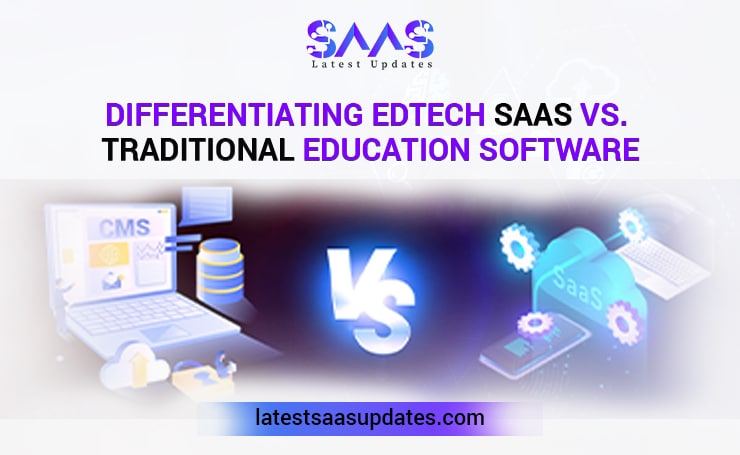
Have a look at how these two softwares differ from each other.
Deployment and Maintenance
Traditional Software: This educational software is installed on local devices and servers. Therefore, it requires IT resources for maintenance. You need a team for traditional software that can delay deployment.
Edtech: This software is completely cloud-based. It does not need the installation or maintenance of a dedicated in-house IT team. The quick deployment makes it preferable for education SaaS companies.
Accessibility
Traditional Software: This software is limited to certain locations and devices. This limitation of accessibility makes it unsuitable for students looking for remote or mobile access.
Edtech: This software allows accessibility from anywhere in the world. Cloud technology ensures continuous learning in remote and hybrid settings.
Scalability
Traditional Software: If you want to scale this software for new users or courses, you might need additional hardware. Moreover, the expensive upgrades can inhibit growth initiatives.
Edtech: This software is designed with scalability in mind. These SaaS platforms grow with the businesses. You can expand them without additional infrastructure.
Cost Structure
Traditional Software: This software requires a hefty investment cost for hardware, infrastructure and licenses. You also need to pay repeatedly for upgrades and support, which can disturb your budget.
Edtech: This software offers subscription-based pricing. Users only pay for what they use. This approach makes EdTech more economical for businesses that want to optimize resources.
User Experience
Traditional Software: This software does not support innovation. The features are limited, making it harder to evolve with the modern needs of learners.
Edtech: It offers advanced features, like AI and real-time analytics. These features provide an engaging and productive learning experience to students.
EdTech SaaS Products: The Complete Ecosystem
The Edtech SaaS ecosystem encompasses a wide range of solutions. The education saas for teachers and students provides a flexible learning environment.
Some popular Edtech frameworks are:
Learning Management Systems (LMS)
Learning Management System (LMS) delivers and tracks online educational programs. The educators can create, organize and distribute learning material. The students can access these materials by creating an account. It serves as a central hub where learners and educators can communicate and collaborate.
Popular Platforms:
- Blackboard Learn
- Canvas
- Moodle
Student Information Systems (SIS)
The Student Information System (SIS) stores the data of students. The features help in every task, including enrollment, grading, student attendance and communication. You can manage administrative tasks using automation. Also you can use student data to create a curriculum and provide support to pupils.
Popular Platforms:
- PowerSchool
- Ellucian Banner
- Infinite Campus
Assessment and Testing Platforms
Educators can create, administer and grade assessments online using these platforms. These SaaS tools have automated grading and offer detailed analytics.
Some platforms ensure academic integrity by offering proctoring features. Additionally, the use of AI personalizes learning by providing feedback.
Popular Platforms:
- Quizlet
- Google Forms
- Edulastic
- Socrative
Content Creation and Authoring Tools
These tools are used to create engaging learning material. Developers create content using these tools that is accessible online. With diverse material, educators can cater to a wide variety of learners using these platforms. Students get an impactful learning experience with different learning modules.
Popular Platforms:
- Articulate Storyline
- Adobe Captivate
- Elucidat
- Camtasia
Virtual Classroom Solutions
Virtual Classrooms are becoming rapidly popular for online learning. These solutions create an interactive session between teachers and students. Virtual classrooms easily bridge the geographic and time zone barriers. The features include video conferencing, digital whiteboard and screen sharing.
Popular Platforms:
- Zoom
- Microsoft Teams
- Google Classroom
Analytics and Reporting Platforms
These tools are fundamental in the evolving education sector. They collect, analyze and present data related to EdTech. These insights show the usage and learning outcomes of technological education. They also show how learners interact with training material and the gap areas that should be adjusted.
Popular Platforms:
- Clever
- Nearpod
- Quizizz
- Kahoot!
Communication and Collaboration Tools
These digital platforms make interaction between teachers and students easy. They have different options, such as video conferencing and messaging. These platforms also have project management and LMS. Educators and learners can share learning materials, collaborate with each other and enjoy the learning process.
Popular Platforms:
- Miro
- Trello
- Google Meet
- Slack
Administrative and Operations Software
Educational institutions use these platforms to manage all tasks related to administration. These tools streamline operations and provide efficiency. You can manage resources (classrooms, equipment and materials) through this software. Data analysis helps educational businesses make better decisions.
Popular Platforms:
- Schoology
- Workday Student
- ClassDojo
- Classter
Use Cases of EdTech SaaS
EdTech SaaS has various uses across different industries apart from the education sector.
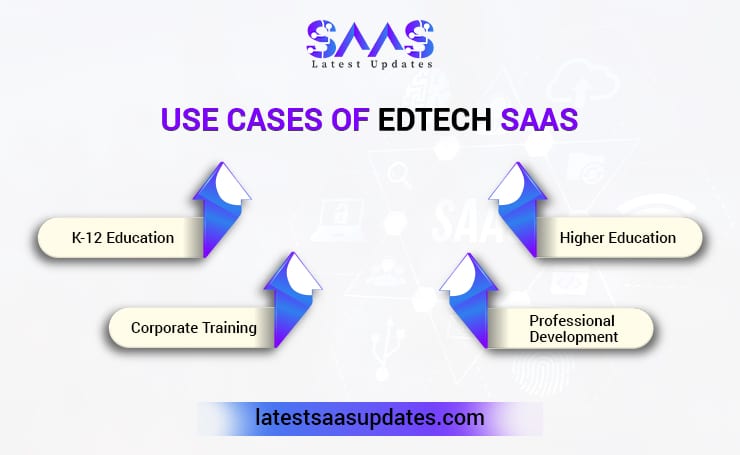
K-12 Education
- This software is making classroom management easier than ever. Educators use it to assign homework, organize lessons and see how students perform.
- Teachers use EdTech communication tools to stay connected with parents. This helps in reporting to them about their children’s behavior and study progress.
- Many EdTech platforms have analytical dashboards. They show how the students are interacting with their studies. This data makes grading easier.
Higher Education
- In higher education, professors can use these tools to deliver a course. They can use virtual classrooms and LMS platforms.
- These SaaS platforms are ideal for research as well. Professors and students can collaborate with each other for research purposes.
- You can streamline your operational tasks better with Edtech SaaS tools. They handle admissions, billing and scheduling.
Corporate Training
- These platforms are widely used in corporate settings too. New hires use these tools to access orientation and training material.
- Organizations use the advanced features of these apps to improve the skills of employees. An employee can enhance their soft and technical skills using EdTech.
- Corporate offices also use these platforms to provide training on company policies and industry regulations.
Professional Development
- Many professionals seek to enhance their skills further by using online course programs. These programs offer certifications as well.
- Many online courses are self-paced. That means that you can learn according to your schedule and improve your skills according to current industry trends.
- If you work in a specific industry, you can get training tailored to your needs. From healthcare to finance, you can enhance your knowledge of any area.
Essential Features of an EdTech Software
Apart from core functionality, all EdTech SaaS platforms should have advanced technological features. These modules make them easy to navigate for users and deliver efficiency.
Core Functionality Features
EdTech SaaS uses different processes to authorize user management and roles. You have to make an account to get access to the training material and ensure you comply with security standards.
Moreover, the educators deliver content in both video and text form. They also assess your progress and can evaluate your interaction using analytical tools.
Technical Features
The EdTech SaaS companies create these applications with mobile responsiveness in mind. Many educators and students access these platforms on smartphones. Some tools are even accessible offline.
These platforms are very easy to integrate with your existing system. They use the API for this purpose. Additionally, both teachers and students can export and import data on these platforms.
Advanced Features
Many Edtech platforms have advanced features to help users further. They are integrating AI to help you personalize the tools. It makes your operations smooth while ensuring accuracy. The cutting-edge analytics and reporting feature monitors daily, weekly and monthly progress.
Gamification elements are all the rage. They sharpen the students’ minds for better performance through engagement and entertainment.
Moreover, many apps are adding accessibility features for people with disabilities. Users with auditory, visual and cognitive impairments can also continue their learning with these cutting-edge features.
A Step-by-Step Guide to EdTech SaaS Implementation
Do you want to integrate an EdTech SaaS platform into your institution? Follow the steps given below.
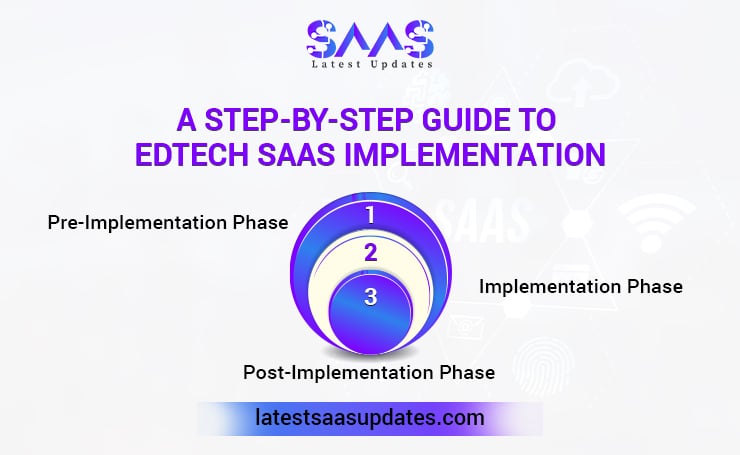
Pre-Implementation Phase
In this phase, organizations get ready to implement new software.
- Firstly, you need to assess the needs of your company. What educational goals do you want to achieve? What are the challenges you are facing?
- You should include educational stakeholders in this decision, such as teachers, IT staff, administrators and even students.
- Estimate the budget. Explore different options and look at their subscription pricing, cost of training and integration.
- Before choosing, you need to evaluate the vendor’s reputation. See if they are compliant with security. Also, assess your long-term goals.
Implementation Phase
After selecting the tool, the implementation phase starts.
- Plan how you are going to shift data to the new platform, including students’ information and other records.
- Make sure to conduct training sessions for teachers, administrators and other staff who will use this platform.
- Before fully launching the platform, do a test on a small group.
Post-Implementation Phase
After launching the Edtech system, the post-implementation phase starts.
- You need to track login frequencies and usage metrics continuously. If there are any training gaps, address them immediately.
- Use the features that show analytics and student progress. Evaluate system responsiveness and refine it accordingly.
- If you or any staff member faces a technical or usability issue, ask for support from the vendor and the company’s help desk.
- Don’t forget to ask for feedback from your staff. Keep an eye on any upgrades and keep the platform evolving according to your business needs.
Leading EdTech SaaS Companies
An EdTech company builds educational technology software and delivers it to customers. You have to purchase these tools on a subscription basis.
Below are some of the top companies providing online platforms for learning.
Coursera: It provides online courses and specializations from top universities around the world. With 113 million users, it has a great impact on e-learning. All courses from this platform are recognized in educational institutions.
Duolingo: It is one of the leading language learning platforms. There are currently 500 million students. With its adorable green bird logo, this app is constantly expanding with new features and courses.
Outschool: It provides online classes to children aged 3 to 18 years. The topic selection is wide, from cooking to coding and theater. Outschool also offers clubs and educational camps for special kids.
Preply: This platform offers language development courses in groups and 1-on-1 tutoring sessions. It has a broad range of educators who teach 12 different languages. Every month, 100,000 students select Preply to start their learning journey.
Labster: This company has an innovative way of making learning fun. Labster provides virtual lab simulations and interactive science experiments. It also uses AR and VR technology for real-life physics, chemistry and other science laboratory experiences.
Lessonly: Organizations use this platform to train their in-house staff. The aim is to provide information that employees can apply to their work.
CreativeLive: It offers live and on-demand classes for video creation, design, photography and other fields. You can learn from industry leaders and even Pulitzer Prize winners.
Panorama Education: It empowers students by offering a personalized learning experience. Institutions can collect data and track it to understand the behavior of teachers and students.
Remind: With this tool, educators connect with students and parents. Teachers send reminders for assignments and any upcoming events. Parents can monitor their child’s progress in their studies.
EdTech SaaS Pricing Models
These online education platforms provide different pricing structures. Opt for the one that aligns with your institution’s needs.
Per-User Pricing
When a service provides the same plan for multiple users, each person is charged a fixed price. The total cost depends on how many users are added.
Pros
- Simple pricing structure
- Scalable
Cons
- The cost doesn’t reflect the service.
- It can become expensive when more users are added.
Per-Feature Pricing
In this structure, you pay only for the features you use. You can upgrade your package to access additional features.
Pros
- Pay for only what you need
- Highly customizable
Cons
- Limited access to advanced features unless you upgrade
- Complex to manage multiple features
Enterprise Pricing
This is a custom pricing model. It is ideal for large institutions that need support for thousands of users.
Pros
- Volume discounts that reduce per-user cost
- Custom features for a large number of users
Cons
- It may include features you don’t need but have to pay for.
- Higher upfront amount
Choosing the Right EdTech SaaS Tool
There are several factors to consider before choosing the right EdTech SaaS tool.
Accessibility: The most important thing to see in an online learning tool is its accessibility. Students and learners should be able to access it from anywhere in the world.
Goal Alignment: The tool should have all the features that can support students’ goals for education. The interface should be easy to navigate as well.
Data Feedback: It is necessary to keep the discussion between students and teachers open. The data and statistics show how students are engaging with their homework and assignments.
Data Privacy and Security: Data privacy is a primary concern for any online learning platform. You should select the tool that has enhanced security with an ISO certification.
Future of EdTech SaaS
The education sector is already undergoing a revolution due to EdTech software. Below are some technological trends that are reshaping the future of this industry.

- AI integration is making learning easy for every student. You can get feedback, predictive learning and tutoring systems to retain knowledge.
- Nowadays, EdTech SaaS tools are becoming more mobile-friendly. Students get offline accessibility and a user-friendly interface for hassle-free learning.
- These platforms are using gamification to make learning more enjoyable. Elements like leaderboards and rewards make even the tough subjects easy to grasp.
- Real-time analytics play a fundamental role in showing what strategies work. Educational institutions can make effective course planning by tracking the progress of students.
- These SaaS platforms are easy to integrate with emerging technologies like IoT and blockchain. This integration allows education institutes to cater to teh evolving needs of learners and educators.
- These platforms emphasize lifelong learning. Professionals can upskill for career advancements and get a competitive edge in the job market.
Conclusion
The education sector has gone through a significant technological advancement in recent years. The increase in EdTech SaaS solutions has made learning and teaching easy for both students and educators.
In this blog, we explored how this online technology is changing the landscape of education. Whether you teach or learn, this advancement is sure to make your education journey seamless. If you want to know more about SaaS, feel free to explore The Latest SaaS Updates.
FAQs
What does EdTech SaaS mean?
EdTech Saas stands for Educational Technology Software as a Service. It is a cloud-based system that operates on a subscription model. It helps manage, organize and create training materials for an engaging learning experience.
Who uses EdTech SaaS platforms?
This software is ideal for teachers, students, educational institutions and corporate teams.
Do EdTech SaaS platforms work offline?
The majority of Edtech platforms require an internet connection. However, some may offer limited offline features.
What is the cost of EdTech SaaS?
These tools offer free to enterprise-level pricing packages. The cost depends on providers and the features they offer.
