
Goals are important for a business’s success. HR teams oversee performance management to ensure that employees meet these goals. However, it is tough to balance it. HR executives have to evaluate employees fairly, prevent managers from burning out, and prevent demoralizing the workforce. Then OKRs came along and tried to fix the gaps in goal-setting.
But there is a problem. Many HR professionals treat performance management and OKRs as the same system or, worse, as competing systems. The truth is, both frameworks are built for different tasks, and HR teams should understand how to run them in parallel to really get transformational results.
This guide is all about how to manage both of these frameworks to drive success, set goals transparently, and encourage employees.
30-Second Summary
- OKRs and performance management are different, but they create better alignment and employee growth when integrated.
- Strong OKRs focus on measurable outcomes. Performance management focuses on development, behaviors, and consistency.
- HR teams can improve retention, engagement, and overall organizational performance through continuous feedback and quarterly goal tracking.
- To create a balanced system, HR teams combine KPIs, OKRs, and performance management for strategic and long-term stability.
Understanding Performance Management in the Modern Workplace
Performance management in a modern workplace is a set of techniques to help managers assess employees’ work. It aligns employees’ performance with the company’s goals. It uses feedback and communication to set goals and expectations.

Performance management creates an environment where the workforce performs to the best of its ability and is also included in goal-setting. It is used both in the public and private sectors.
What Is the OKR Framework And Why HR Should Care
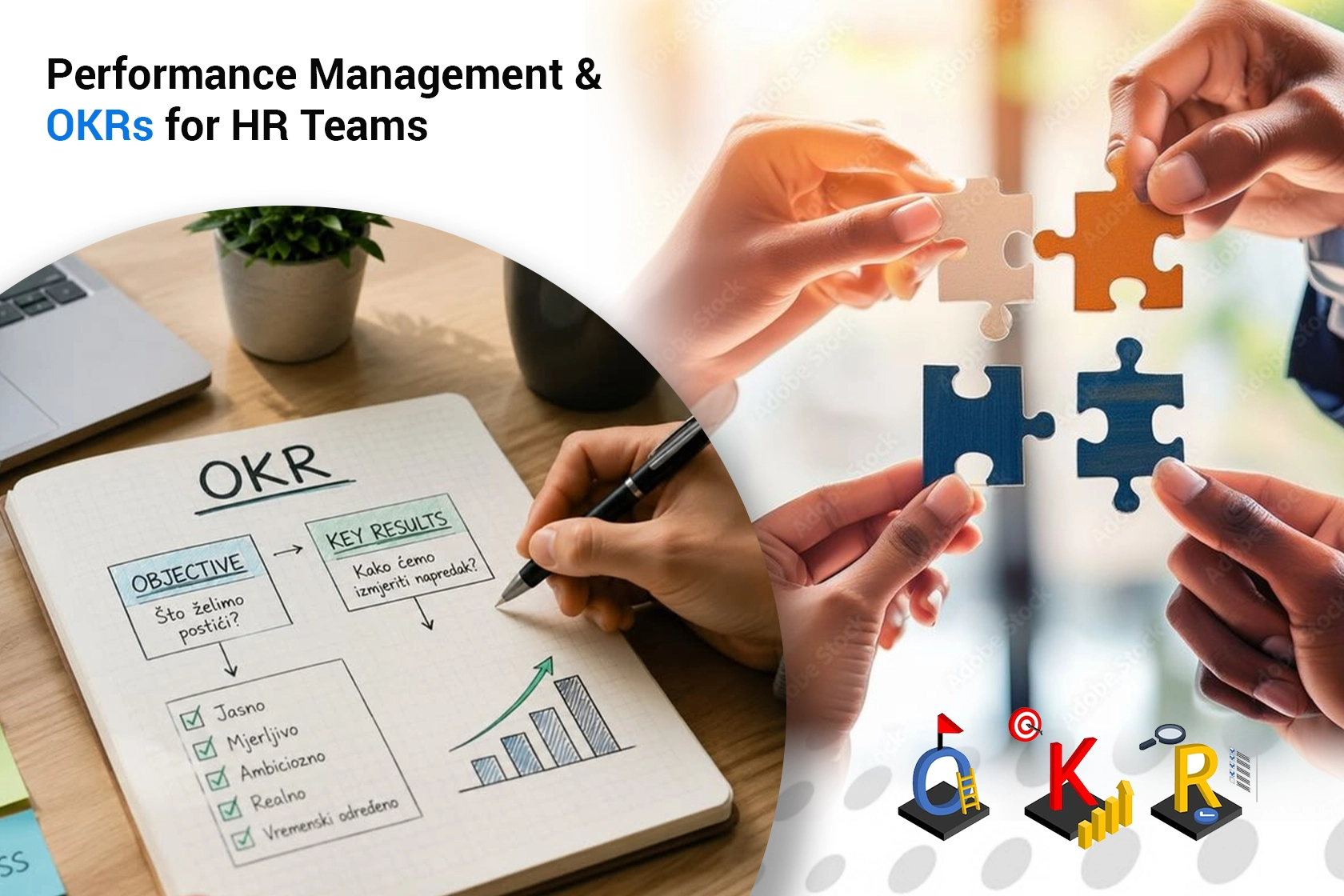
OKRs are basically a goal-setting framework. It has two major components: Objectives and Key Results.

- Objectives are the qualitative, ambitious goals that a team or an employee aims to achieve. These usually align with an organization’s overall vision and mission.
- Key Results are measurable, time-bound, and quantitative outcomes that show how a team will achieve its Objectives. They are specific and trackable, representing the growth towards achieving the Objectives.
Why OKRs Matter for HR Teams

- OKRs connect individual and team goals directly to the high-level strategy of an organization, ensuring everyone works on that one thing that matters the most.
- OKRs foster a culture of belonging and engagement in an organization. HR teams can use them to reduce turnover rates as well.
- OKRs allow HR executives to improve the pipeline of skilled employees and future leaders. They can increase the number of employees with cross-functional skills and improve job performance.
How OKRs and Performance Management Are Different (But Complementary)
| Aspect | OKRs | Performance Management |
| Primary Focus | Measures business outcomes and strategic results | Evaluates employee performance, behaviors, and competencies |
| Scope | Aligns company, team, and individual goals | Focuses mainly on individual growth and job performance |
| Timeframe | Short-term cycles, usually quarterly | Continuous process with periodic reviews |
| Ambition Level | Encourages stretch goals and experimentation | Emphasizes realistic and consistent performance |
| Transparency | Public and visible across teams | Private and confidential between managers and employees |
| Compensation Link | Typically not tied directly to pay or bonuses | Often connected to raises, bonuses, and promotions |
| Review Frequency | Frequent check-ins and progress tracking | Formal annual/semi-annual reviews with ongoing feedback |
| Goal-Setting Style | Collaborative and strategy-driven | Role-based and development-focused |
How They Complement Each Other
OKRs decide what an organization needs to achieve. Performance management ensures that employees develop desired skills, behaviors, and consistency to achieve those goals.

Anatomy of a Well-Written OKR
Strong OKRs ensure that you achieve the most ambitious goals. Let’s see how you can write excellent OKRs.
Identify Your Priorities
OKRs are not a to-do list. You need to reserve them for a few goals that make the biggest impact on your organization. Before writing, HR teams need to ask a few questions.

- What are the most important things they need to accomplish this quarter?
- If they got any of them done, what would meaningfully improve?
- What needs to change from where they are today?
If there are five items in your list, narrow it down to three. Ask of each item: why does this matter right now? You will notice a few priorities rise above the rest. These will be the foundation of your OKRs.
Write Your Objective
Now, take these priorities and convert them into Objectives. A good Objective is inspirational, concrete, action-oriented, and significant. Here’s what it looks like for an HR team struggling with employee retention.
- Vague starting point: Improve retention in the company
- More actionable and specific objective: Reduce voluntary turnover across all departments by the end of Q3.
- Inspirational and sharp: Make the organization the kind of place where talented people actively choose to stay.
Write Your Key Results
Key Results do not need to capture everything that needs to happen; they capture the fewest meaningful results that show that you are reaching your Objectives.

For example, an HR team has to fix its broken onboarding process. New hire feedback is poor, managers are not satisfied with new joiners’ performance, and early attrition in the first 90 days is rising. The team creates a single Objective: Fix onboarding so new hires are set up to succeed from the first day. Then, the team will define four Key Results to know whether they have succeeded.
- KR1: Increase new hire 30-day satisfaction score from 58% to 80%
- KR2: Reduce early attrition from 22% to 10%
- KR3: Achieve 90% manager satisfaction rating with new hire readiness by the end of week 4
- KR4: Complete structured onboarding documentation for 100% of roles by the end of Q2
Good OKRs have three main qualities. They are
- Time-bound and specific
- Realistic
- Measurable without ambiguity
Remember, it is not a Key Result unless it has a number.
Calibrate Stretch Goals
Early on, HR teams often write OKRs that fall into one of the two traps. Either these goals are too ambitious to be demoralizing or so safe they require no proper effort.

For example, an HR team with a current eNPS score of 15 sets an Objective to become the most engaged workplace in their industry. It is directionally right, but unrealistic in a single quarter. The stretch goal here (the one that pushes meaningfully without setting the HR team up for failure) might look like
- Increase eNPS from 15 to 35 by the end of Q3 and identify the top three drivers of disengagement through a structured pulse survey.
Notice how this version is ambitious and needs real work. However, it is still achievable, and when an HR team hits it, it would represent real progress.
The ideal spot for stretch goals is an OKR that your team can achieve 60 to 70% under proper effort. If you are achieving 100% of your OKR, your goals are not stretching far enough. If you are missing consistently, adjust the goal instead of giving up on it.
Choose two to three Objectives that would make a meaningful difference and pair each of them with three to five Key Results that reflect the direction you are heading in.
Building a Performance Management Cycle That Works
The performance management cycle uses feedback, support, and evaluation to support employee growth and align it with a company’s goals. This cycle has four components.

- Planning: Development plan, employee goals, measurable organizational objectives, and important skills and behaviors for success.
- Monitoring: Meetings and reevaluations to assess employees’ continued progress.
- Reviewing: At the end of the biannual or annual cycle, to enable management and employees to assess the process and the results.
- Rewarding: Perks such as bonuses, salary increments, and acknowledgments to recognize employees’ dedication and incentivize them.
How to Maintain a Successful Performance Management Cycle?

- Set Practical Goals: First, identify results you want to ensure the goals are doable and challenging. Prioritize a few of them to ensure employees can realistically achieve them.
- Provide Feedback With Respect and Care: Give feedback immediately, but do not bombard the employee with input. Hold a meeting in a quiet space and focus on behavior. Make feedback two-way by also asking the employee’s perspective.
- Monitor Performance Regularly: Monitor your employees’ progress frequently, around every month or every three months. It allows you to deal with issues as soon as possible without them becoming overwhelming.
- Use Performance Management Tools: Such software can streamline the entire performance management process. It gives you a platform where you can establish goals and their timelines and store and share performance reviews.
Implementing Quarterly OKRs Across the Organization
Rolling out OKRs across your company might be challenging, particularly when no one is familiar with them. However, here is how you can make the implementation process easier.

- Start Small: Provide clear Objectives to the teams. One way is to do a pilot test to see if it will work or not. Remember, not every department or team needs OKRs, and not all companies’ OKRs are going to be the same.
- Implement Quarterly: Start rolling out OKRs on a quarterly basis to better understand them.
- Set 2 or 3 Goals: Start small, set goals at the beginning of the year, and communicate with employees so they are on board as well.
- Check the Progress: Keep checking OKRs frequently and adjust if needed.
Key Performance Indicators vs. OKRs: Using Both Strategically
| Aspect | KPIs | OKRs |
| Primary Purpose | Tracks ongoing business performance and health | Drives strategic change and goal achievement |
| Focus | Measures steady-state performance | Targets ambitious outcomes and improvements |
| Nature | Metrics-based and operational | Goal-oriented with measurable key results |
| Timeframe | Continuous and long-term tracking | Usually set quarterly or within fixed cycles |
| Ambition Level | Maintains benchmarks and consistency | Encourages stretch goals and innovation |
| Flexibility | Relatively stable over time | Updated frequently based on priorities |
| Usage | Monitors “business as usual” activities | Aligns teams around strategic initiatives |
| Examples | Customer retention rate, churn, website uptime | “Increase customer retention by 20% in Q3.” |
| Success Definition | Staying within target range | Making meaningful progress toward Objectives |
| Visibility | Often tracked in dashboards and reports | Shared across teams for alignment and accountability |
Use KPIs to monitor your business’s ongoing health and identify performance gaps. Then, use OKRs to drive focused improvements and strategic changes in the areas that matter the most.
Team Performance Tracking: Keeping Visibility Without Micromanaging
Tracking your team’s performance without micromanaging requires managers to shift their focus from what employees are doing daily to outcomes, shared accountability, and transparent communication.

For example, define what a “done task” looks like to your employees and let them achieve it. Measure results like sales per hour or project milestones instead of hours worked. Moreover, you should use project management software, such as Asana or Trello. They allow you to track progress in real time and eliminate the need for status update meetings.
Another way is to encourage your employees to own their progress by preparing updates on roadblocks and accomplishments, and next steps before meetings.
Continuous Performance Management: Moving Beyond the Annual Review
Despite their use in almost every company, annual reviews often face criticism from employees and managers due to their bias, lack of context, and infrequency. This is shifting the focus towards continuous performance management. It includes

- Regular check-ins
- Ongoing feedback
- Goal setting and tracking
- Performance coaching
- Continuous learning
Continuous performance management has several benefits.
- It improves employee engagement through regular feedback. Employees feel more connected to their organization and work.
- Regular check-ins allow employees to understand where they stand and align their efforts with changing business priorities.
- Feedback and support encourage employees to address the challenges they face, thereby enhancing their performance.
- Ongoing communication and development reduce turnover rate by increasing job satisfaction.
Companies that have implemented this system have seen significant improvements. For example, Adobe was able to reduce involuntary turnover by 30% after adopting a continuous performance management approach.
Aligning OKRs with Organizational Strategy
Every organization needs different strategies to run effectively. Here are the 5 most important ones and how OKRs help to achieve them.

Competitive Strategy
This strategy compares your company’s strengths and weaknesses and identifies what differentiates you from your competitors. OKRs help shift the focus to becoming better, winning over your rivals, and standing out.
Corporate Strategy

As a company grows, its structure and functions become more complex. A corporate strategy shows what is necessary for all departments to achieve together. OKRs help complex teams to coordinate as goals and priorities change in the long-term company mission.
Business Strategy
Business strategy focuses on how different parts of a company achieve growth, get new opportunities, and compete in the market. Large organizations use separate strategies for different business units or revenue models.
OKRs help employees stay aligned with business priorities and ensure everyone focuses on the organization’s chosen direction.
Functional Strategy
Functional strategies make some of your organization’s capabilities stronger. These include customer service, operations, marketing, and product development. Functional strategies create long-term competitive advantage.
OKRs help the workforce prioritize improvements. Teams can track progress to see how much the core capabilities of the business have strengthened.
Operating Strategy
This strategy is all about how organizations execute their work efficiently through systems, resource management, daily operations, and processes.
OKRs support execution by setting clear priorities, improving accountability, and helping teams adapt quickly while also tracking operational progress.
HR-Specific OKR Examples by Function
To make the concept of HR concrete, here are some examples.
Talent Acquisition

- Objective: To establish a recruiting process that speeds up the hiring of top talent
- Key Results: Reduce average time-to-fill from 45 days to 28 days. Achieve an acceptance rate of 85% and fill 95% of open roles internally before hiring employees externally.
Employee Engagement
- Objective: Make the workplace and its environment positive, where people willingly want to stay.
- Key Results: Increase employee participation in the engagement survey, raising it from 60% to 85%. Improve manager effectiveness scores by 15 points. Launch and complete 3 cross-functional recognition programs.
Learning Development

- Objective: Build a culture where growth is ongoing and visible.
- Key Results: Achieve 80% completion on mandatory compliance training by the end of Q1. Launch a mentorship program with 50 active pairs. Increase internal promotion rate by 20%.
Common Pitfalls HR Teams Face with OKRs and Performance Management

- Setting too many OKRs, as it can spread the attention thin, and nothing gets real focus
- Treating OKR scores as performance ratings
- Skipping retrospectives
- Making performance appraisal a formality
- Not training managers, as they are the ones handling performance reviews of employees
Bringing It All Together: An Integrated HR Strategy
Despite being distinct concepts, performance management and OKRs can create a powerful collaboration when integrated properly.

Creates Strategic Alignment
OKRs tell you the “what,” meaning all the Objectives a company needs to pursue. Performance management establishes the “how,” which helps in developing the team and behaviors needed to achieve those Objectives.
For instance, when Google implemented OKRs, it saw a 29% improvement in performance metrics and a 32% increase in employee engagement.
Improves Performance Conversations
Combining OKRs with performance reviews provides measurable data points for assessment. Instead of a subjective evaluation, managers can discuss progress toward key results. They can learn about the skills employees developed during the process and how they faced obstacles. This approach makes performance reviews more structured and allows employees to grow with proper feedback.
Best Integration Practices
- To avoid confusion, maintain OKR planning on a quarterly basis and performance reviews on an annual or semi-annual basis.
- OKRs should be one factor in performance reviews. You should also consider collaboration, behaviors, and effort alongside results.
- OKRs are often collaborative. So, assess every individual’s contributions to team Objectives rather than treating OKRs as individual performance.
- Use OKR retrospectives to understand skill gaps and identify learning opportunities. This analysis should feed directly into individual development plans.
Final Thoughts
OKRs and performance management are different tools. Treating them the same is where HR teams mostly fail. OKRs allow teams to pursue ambitious and meaningful outcomes. Performance management ensures that every employee grows, receives a fair evaluation, and receives appropriate rewards.
Both of these systems work perfectly as they create a culture where people know what winning is. People trust the fairness of the system and identify how their work connects to something bigger than just their job description.
For more blogs on HR SaaS, visit Latest SaaS Updates.
FAQs
What are the Best OKR examples for HR Teams?
The best HR OKRs focus on measurable improvements in employee engagement, retention, hiring, learning, and leadership development.
How do OKRs Improve Employee Performance?
OKRs enhance employee performance by providing clear priorities, communicating measurable goals, and resulting in proper alignment between individual work and company strategy.
What is the Difference between SMART Goals and OKRs?
SMART goals are all about completing specific tasks. OKRs, on the other hand, emphasize ambitious Objectives that are supported by measurable outcomes.
How do Continuous Performance Management Systems Benefit Employees?
Continuous performance management helps employees receive regular feedback, clear expectations, support, and better career development opportunities.
